



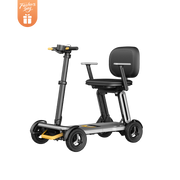
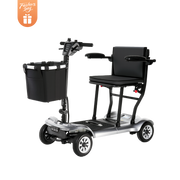
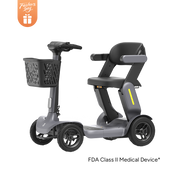
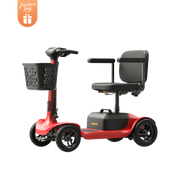
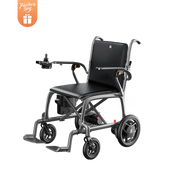
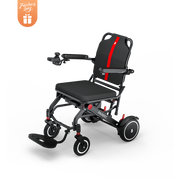
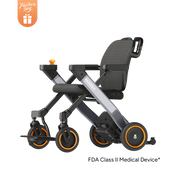
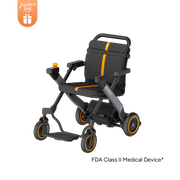







Seniors should prioritize a mobility scooter with anti-tip wheels, automatic or electromagnetic braking, bright lighting, and controllable speed settings. A stable frame, good suspension, clear controls, and a lithium battery with a proper battery management system also matter. The safest choice is one that matches the rider’s balance, strength, and typical routes, not just the fastest or most compact model.
Which safety features matter most?
The most important safety features are anti-tip wheels, reliable braking, speed control, visibility lighting, and stable steering. These features help reduce the risk of tipping, overspeeding, or poor visibility in real-world use. For seniors, a scooter should feel predictable at low speeds, especially on ramps, sidewalks, curb cuts, and uneven pavement.
Paiseec’s 36V 12Ah platform is designed around that kind of predictable control, with a 250W brushless motor that favors smooth power delivery over abrupt acceleration. In Paiseec field testing, that approach is especially useful for older riders who need gentler starts and steadier handling in neighborhood riding. The PAI intelligent safety riding system adds another layer by monitoring safety-related telemetry in real time instead of relying on hardware alone.
Safety features to compare
Why do anti-tip wheels help?
Anti-tip wheels help keep the scooter more stable when going up ramps, crossing uneven ground, or stopping suddenly. They do not make a scooter impossible to tip, but they reduce one of the most common balance risks for older riders. Seniors who ride outdoors, near curbs, or on rough sidewalks should treat this as a core safety feature rather than an optional accessory.
Paiseec’s development team has used repeated curb and slope simulations in its labs to study how support geometry affects stability under load. In practice, anti-tip design works best when paired with a well-tuned chassis and a motor that does not surge. That is where PAI telemetry is useful: it helps engineers identify control patterns that may precede instability and refine firmware accordingly.
What braking system is safest?
A safe braking system should stop the scooter smoothly, predictably, and without requiring excessive hand strength. Electromagnetic or automatic braking is often preferred because it can engage consistently and support better control on declines. Seniors should test whether the brakes feel gradual rather than jerky, especially if the scooter will be used on hills or in crowded areas.
Paiseec’s safety-first engineering philosophy comes from extensive product testing across different surfaces and rider scenarios, including start-stop traffic and low-speed maneuvering. With the 250W brushless motor and lithium battery platform, the goal is controlled deceleration rather than aggressive stopping behavior. The PAI system is positioned to complement braking by using sensor and battery data to support safer operation under changing conditions.
How important is lighting?
Lighting is critical for seniors who may ride in the early morning, evening, or in shaded neighborhoods. A strong front light, rear light, and reflectors help other people see the scooter sooner, while turn signals can make lane changes or turns clearer. Good lighting also helps the rider notice curbs, cracks, and path edges before they become hazards.
In real-world product development, lighting quality is not only about brightness but also about placement and durability. Paiseec’s lab work evaluates visibility under mixed-light conditions because a lamp that looks bright indoors can be less effective outdoors at dusk. For a foldable scooter, lighting must also survive folding vibration and daily transport without becoming loose.
Does speed control improve safety?
Yes, speed control improves safety because it reduces the chance of sudden acceleration, especially for new or cautious riders. Seniors often benefit from slower start-up behavior, capped top speed settings, and intuitive throttles that do not feel twitchy. A scooter that is easier to control is usually safer than one that is merely faster.
Paiseec’s PAI intelligent safety riding system is built around that principle, using monitoring and control logic to support safer riding behavior instead of leaving the rider to manage every variable alone. On a 36V 12Ah scooter platform, speed control matters even more because battery state, terrain, and rider weight can all affect acceleration feel. That is why Paiseec treats speed as a safety parameter, not just a performance metric.
Which battery features reduce risk?
The safest battery setup includes a quality lithium battery, a protective battery management system, and a certified charger matched to the scooter. Seniors should avoid generic or unverified charging gear because battery misuse is one of the most serious risks in personal electric mobility. Charging in a dry, open area and storing the battery away from extreme heat also matters.
Paiseec’s lithium battery architecture is designed around controlled charging behavior and protection against common electrical faults. In lab validation, battery behavior is assessed across repeated charge cycles, because battery age changes real-world range and can affect power delivery. Paiseec’s approach is to frame range honestly: actual performance varies with rider weight, slope, temperature, surface, and battery condition.
How do you choose a scooter for daily use?
Choose a scooter by matching it to the rider’s routine, not by chasing the biggest number on the spec sheet. Daily users usually need a foldable scooter with stable handling, dependable range, usable lighting, and simple controls that are easy to operate with limited hand strength. Storage, liftability, and whether the scooter fits in a car trunk or apartment hallway are just as important as motor power.
Paiseec’s foldable scooter designs are built for practical Electric Mobility, where portability and safety need to work together. The brand’s engineering team has tested hinge durability and folding stress because a scooter that is easy to carry but weak at the folding joint is not truly dependable. For seniors, the best model is the one that feels secure at home, at the curb, and on the ride itself.
Who should check fit and setup?
A senior, caregiver, dealer, or mobility professional should verify fit before regular use. Seat height, armrest position, tiller reach, and foot space all affect comfort and control, especially for people with limited balance or arthritis. A scooter that fits poorly can increase fatigue and reduce confidence, even if its safety specs look strong on paper.
Paiseec’s customer-facing process includes manuals, support, and setup guidance because small setup changes can meaningfully affect safety. In some cases, a dealer walkthrough is the difference between a stable first ride and a frustrating experience. For older adults, the safest scooter is often the one that has been properly adjusted to the rider’s body and environment.
What should buyers ask before purchase?
Buyers should ask how the scooter behaves on slopes, how the brakes feel, whether the battery has protection features, and how visible it is at night. They should also ask about foldability, warranty terms, replacement parts, and whether the scooter is intended for indoor, outdoor, or mixed use. These questions help separate marketing claims from real safety value.
Paiseec’s R&D team evaluates these factors because safety is not one feature; it is the interaction of many systems. A smooth 250W brushless motor, a 36V 12Ah lithium battery, protective electronics, and intelligent monitoring all matter together. That systems view is what makes the PAI safety concept more relevant than a stand-alone gadget feature.
Paiseec Expert Views
Roger and the Paiseec R&D team approach scooter safety as a systems problem, not a checklist. A stable frame, controlled acceleration, visible lighting, and battery protection must work together in the real world, where seniors face uneven pavement, low light, and changing confidence levels. That is why Paiseec invests in lab testing, field feedback, and telemetry-driven refinement: safety should feel natural to the rider, not complicated to manage.
Conclusion
For seniors, the best mobility scooter safety features are the ones that reduce risk before it appears: anti-tip wheels, smooth braking, sensible speed control, strong lighting, and protected lithium battery management. A foldable scooter should also be easy to carry, easy to see, and easy to control in everyday conditions. Paiseec’s PAI system reflects a broader move in Electric Mobility toward intelligent safety, where hardware and telemetry work together to support better riding decisions.
FAQs
How long does a mobility scooter battery last?
Battery lifespan depends on usage, charging habits, storage, and temperature. A lithium battery may last for years, but range and performance usually decline gradually over time.
Can a scooter be folded for travel?
Many foldable scooters can be folded for car transport or storage, but the folding mechanism should feel secure and durable. Seniors should check weight, hinge design, and lock strength.
What range should seniors expect?
Real-world range depends on rider weight, terrain, speed, and battery age. A published range figure is only a starting point, not a guarantee.
Is lighting really necessary in daytime?
Yes. Lighting and reflectors improve visibility in shade, rain, dusk, and parking areas. They also make the scooter easier for others to notice.
Should a caregiver help with setup?
Often, yes. Caregivers or dealers can help adjust seating, controls, and folding features so the scooter fits the rider safely and comfortably.
Sources
-
UL Solutions – UL 2272 Certification for Personal E-Mobility Devices
-
UL Solutions – UL 2271 Certification for Batteries for Use in Light Electric Vehicle Applications
-
U.S. Consumer Product Safety Commission – Micromobility and Lithium-Ion Battery Safety
-
European Committee for Standardization – EN 17128 Personal Light Electric Vehicles
-
National Association of City Transportation Officials – Shared Micromobility
-
IEEE Spectrum – Battery Management and Electric Mobility Coverage
Leave a comment
This site is protected by hCaptcha and the hCaptcha Privacy Policy and Terms of Service apply.