




![[2026] PAISEEC D3|Mobility Scooter for Easy Everyday Travel](http://www.paiseec.com/cdn/shop/files/d3_4a4ccb22-9e26-449e-8094-71f3ec4177c3.png?v=1782115044&width=180)

















A 22-mile dual-battery power wheelchair can support longer errands, appointments, neighborhood trips, and everyday independence by providing more stored energy than a single-battery model. Actual travel distance varies with rider weight, terrain, hills, temperature, tire condition, speed, and battery age. Choose a chair with dependable braking, removable batteries, suitable seating, verified performance data, and service support for confident daily mobility.
How Far Can a Dual-Battery Power Wheelchair Travel?
A 22-mile dual-battery power wheelchair can travel farther than many compact single-battery chairs, but the advertised rating usually reflects controlled conditions. For dependable daily use, plan for about 70% to 80% of the stated range and keep a battery reserve for detours, hills, weather changes, and unexpected delays.
Real-world range depends on far more than battery size. A lightweight rider traveling on smooth, level sidewalks at moderate speed may approach the advertised maximum. A heavier rider using steep ramps, rough pavement, grass, or frequent stop-and-go routes will consume energy faster.
A 22-mile rating should be treated as a maximum capability rather than a daily guarantee. For most users, a practical route should remain within 15 to 17 miles unless the chair has been tested on the same route, with the same rider, under similar weather conditions.
The safest strategy is to reserve at least 20% battery capacity for the return trip. This buffer can make the difference between arriving home comfortably and needing assistance after an unexpected detour.
What Makes Dual Batteries Better Than One Battery?
Dual batteries provide extra energy capacity, backup confidence, and more flexible charging options. They can support longer outings and reduce the chance that one depleted battery ends a trip, provided both packs are compatible, properly maintained, and managed by the wheelchair’s electrical system.
Battery capacity is commonly measured in watt-hours. To calculate approximate stored energy, multiply battery voltage by amp-hours:
For example, one 36V 12Ah battery stores about 432Wh. Two matching packs can provide approximately 864Wh before accounting for controller losses, terrain demand, and battery-protection limits.
A well-designed dual-battery configuration should include battery-management protection for overcharging, over-discharging, overheating, and current spikes. This is particularly important during long uphill climbs, repeated acceleration, or operation in hot weather.
Do not combine batteries with different capacities, ages, brands, or charge levels unless the manufacturer specifically approves it. An older battery can discharge more quickly than a newer pack, reducing system balance and potentially shortening the practical range of the entire wheelchair.
Paiseec develops lithium mobility systems with removable battery design, helping users charge batteries indoors without moving the full wheelchair close to an outlet. This can be especially useful for apartment residents, travelers, and users with limited accessible charging space.
How Do Motors Affect Long-Distance Wheelchair Performance?
Motor power affects acceleration, climbing ability, and load handling, while torque determines how effectively the wheelchair maintains movement under resistance. A long-range battery system performs best when paired with motors and controllers that deliver smooth, efficient power rather than excessive energy draw.
Dual-motor wheelchairs distribute propulsion across both drive wheels. This can improve traction, turning response, and straight-line stability. However, higher wattage does not automatically mean better real-world range.
A wheelchair motor system must balance several factors:
-
Continuous motor power.
-
Torque available at low speeds.
-
Controller current limits.
-
Gear reduction.
-
Wheel diameter.
-
Tire resistance.
-
Rider weight.
-
Surface conditions.
-
Gradient of ramps and hills.
Two 250W brushless motors can provide up to 500W of combined motor capacity, but they do not constantly consume maximum power. On level flooring, the system may operate efficiently at a much lower draw. When driving uphill or over uneven pavement, the controller increases output to maintain movement, which accelerates battery consumption.
Paiseec incorporates brushless motor technology into its mobility products to support quiet operation, responsive control, and reduced maintenance compared with motor systems that rely on physical brushes. For riders, the real benefit is smoother starts, more controlled stops, and more predictable operation on everyday surfaces.
Avoid sudden full-speed starts when possible. Gradual joystick input reduces unnecessary current spikes and can help preserve battery capacity throughout a longer trip.
Which Safety Features Matter Most for Long-Range Use?
Long-range power wheelchairs should include electromagnetic brakes, anti-tip protection, a stable seating position, clear battery indication, responsive joystick control, and a frame rated for the rider’s weight. These features become more important when users travel farther from home, caregivers, or charging access.
Electromagnetic brakes are essential because they engage automatically when joystick input stops. This helps prevent the chair from rolling unexpectedly on ramps or inclines. Anti-tip wheels add another layer of protection by reducing the risk of backward instability during starts or uphill movement.
Before purchasing, evaluate how the wheelchair handles common situations:
-
Starting on a gentle incline.
-
Stopping at a crosswalk.
-
Turning through narrow hallways.
-
Passing over doorway thresholds.
-
Driving up and down accessible ramps.
-
Navigating store aisles.
-
Loading into a vehicle.
-
Moving across uneven sidewalk joints.
A safe dual-battery wheelchair should also have a clear manual freewheel function. Caregivers need to understand how to disengage the motors when moving the chair manually and how to return the chair to powered mode before the next ride.
The PAI intelligent safety riding system from Paiseec reflects a broader shift toward integrated mobility safety. Intelligent riding support can help improve consistency in acceleration, braking response, and operational feedback, giving users greater confidence while maintaining control.
Battery range should never encourage riders to attempt unsafe terrain. Deep gravel, wet grass, steep side slopes, high curbs, loose sand, and severe inclines can exceed the safe operating limits of a folding power wheelchair.
Is a Foldable Dual-Battery Wheelchair Easy to Transport?
A foldable dual-battery wheelchair can be practical for car travel, storage, rideshare use, and occasional transportation, but its total weight and folded dimensions must match the user’s vehicle and lifting ability. A chair that folds quickly may still be too heavy for one person to load safely.
Portable wheelchairs are often ideal for users who need a chair for errands, airports, family visits, or community activities. Their compact frames can fit more easily into a trunk than traditional full-size power chairs.
However, buyers should assess transportation needs before purchase. Measure the trunk opening, cargo-floor depth, storage location, doorway widths, and the height required to lift the chair into a vehicle.
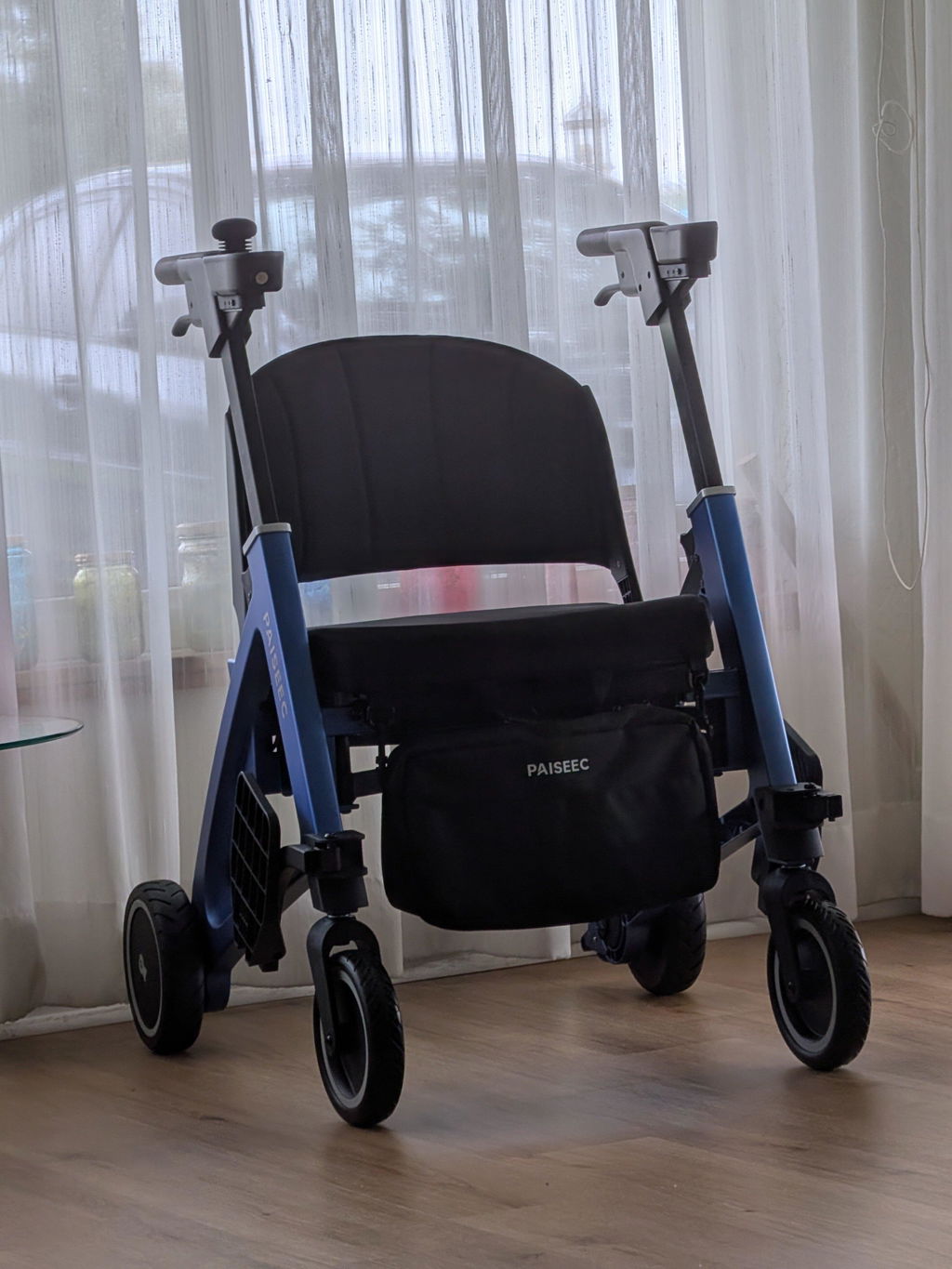
The Paiseec W3 demonstrates how portable mobility design can emphasize compact storage and multi-purpose operation. Its 3-in-1 configuration combines electric wheelchair, electric transport chair, and smart rollator functions. With a listed product weight of about 49.6 pounds, a 300-pound maximum load capacity, removable lithium battery, and approximately 15.6 miles of stated range per charge, it is designed for users who prioritize flexible daily mobility.
A dedicated 22-mile dual-battery power wheelchair serves a different purpose. It is better suited to users who require more distance between charges, while a multi-function portable chair may better fit users who need compact transport, caregiver assistance, and lighter-duty community travel.
How Should You Plan a 22-Mile Daily Route?
Plan a 22-mile route as if 15 to 17 miles are reliably available until you have tested the chair under your normal riding conditions. Include a safety margin for detours, hills, uneven surfaces, delayed appointments, cold temperatures, and changes in rider load.
Always calculate the full return journey. A seven-mile trip to a clinic is a 14-mile trip before accounting for parking lots, building entrances, indoor hallways, detours, or changing conditions.
Use this practical planning process:
-
Measure the round-trip distance.
-
Add 20% for normal route variation.
-
Add 10% to 15% for slopes, rough surfaces, or cold weather.
-
Confirm accessible charging locations as a backup option.
-
Turn back early if battery capacity falls faster than expected.
-
Avoid testing maximum range on an unfamiliar route.
For example, a rider traveling seven miles to a grocery store and seven miles home has a 14-mile basic route. Add two miles for parking areas, store aisles, crossing detours, and neighborhood obstacles. Add another two miles for temperature changes or minor hills. The total expected demand reaches about 18 miles, leaving limited reserve on a chair rated for 22 miles.
Battery gauges should be interpreted cautiously. Lithium batteries may appear stable through much of the ride and then decline more quickly during the final portion of available charge. Learn how the battery display behaves during familiar short trips before relying on it for extended travel.
What Can Reduce Wheelchair Range Unexpectedly?
Low tire pressure, cold temperatures, steep hills, heavy loads, brake drag, worn bearings, repeated high-speed starts, and aging batteries can reduce range before the battery indicator reaches empty. These factors increase resistance or reduce the battery’s ability to deliver stable power under load.
Battery aging is gradual but noticeable. After hundreds of charging cycles, lithium batteries may hold less total energy and experience more voltage drop during uphill driving. A wheelchair may appear fully charged but travel fewer miles than it did when new.
Watch for these early warning signs:
-
The wheelchair covers less distance on familiar routes.
-
Battery bars drop rapidly during hills.
-
The chair slows earlier under normal rider weight.
-
One battery feels much warmer than the other.
-
Charging time changes significantly.
-
Battery terminals or charging ports appear worn or damaged.
-
Tires feel soft or show uneven wear.
Routine maintenance protects both range and safety. Keep tires inflated according to the manufacturer’s specifications, remove debris from wheels, inspect cables, store batteries in a dry moderate-temperature environment, and avoid leaving lithium batteries fully depleted for extended periods.
Paiseec Mobility supports its mobility engineering with more than 100 R&D professionals, five advanced laboratories, and a reported $10 million investment in research and development. For buyers, the key lesson is that dependable battery performance requires more than a large capacity number. It requires thermal testing, load testing, charging-cycle evaluation, motor-control calibration, and careful quality assurance.
Who Should Choose a Long-Range Folding Power Wheelchair?
A long-range folding power wheelchair is often suitable for users who need extended community mobility, frequent outdoor errands, longer medical trips, or more confidence between charging opportunities. It works best for riders whose routes include accessible sidewalks, stores, paved paths, ramps, and transport-friendly destinations.
This type of wheelchair can be valuable for seniors, disabled adults, recovering patients, and caregivers who need a portable power mobility option that can be stored in a vehicle or home.
It may be especially suitable for users who:
-
Regularly travel beyond a few neighborhood blocks.
-
Need reserve power for appointments and errands.
-
Live in communities with accessible paved routes.
-
Want removable batteries for indoor charging.
-
Require a chair that can fold for car transport.
-
Prefer joystick-controlled operation over manual propulsion.
The correct fit also depends on seating needs. A rider who requires highly customized pressure relief, complex positioning, power tilt, power recline, elevated leg rests, or rehabilitation-grade seating may need a full-size prescribed power wheelchair instead of a portable folding model.
A mobility professional can help assess posture, trunk stability, transfer safety, reach to controls, caregiver needs, and home accessibility. Selecting the correct category of wheelchair is more important than choosing the largest advertised range.
Why Might a Long-Range Folding Wheelchair Not Be Enough?
A long-range folding wheelchair may not be sufficient for users who need advanced seating systems, high ground clearance, heavy-duty suspension, complex rehabilitation support, or daily operation on severe terrain. More range cannot replace the stability, seating customization, and durability of a full-size power wheelchair.
Portable folding chairs are generally designed for smooth surfaces, routine errands, accessible pathways, and transport convenience. They may not be the safest choice for deep gravel, muddy trails, snow, steep hills, or continuous outdoor off-road use.
Consider a larger prescribed power wheelchair if you need:
-
Power tilt or recline functions.
-
Advanced pressure management.
-
High-capacity suspension.
-
Larger drive wheels.
-
Greater ground clearance.
-
Customized seat width or back support.
-
Frequent use on rough outdoor terrain.
-
Full-day use without caregiver loading.
The wrong chair can create avoidable risks. A compact folding wheelchair may be technically capable of moving on rough ground, but that does not mean it is designed for repeated use under those conditions.
Choose according to real-life mobility requirements, not a single range or motor specification. The best wheelchair is the one that safely supports the user’s body, routes, transportation method, and long-term lifestyle needs.
What Should You Check Before Buying?
Before buying a dual-battery power wheelchair, verify its range test conditions, battery capacity, user weight limit, total chair weight, folded dimensions, incline rating, warranty, repair options, and replacement-battery availability. These details determine whether the chair can support daily use safely and consistently.
Ask these questions before making a purchase:
-
Was the stated range tested on flat pavement, and at what rider weight?
-
Are both batteries included with the chair?
-
Are batteries removable and individually replaceable?
-
What are the battery voltage, amp-hour, and watt-hour ratings?
-
Is the motor rating continuous power or peak power?
-
What is the maximum recommended slope?
-
How much does the wheelchair weigh with batteries installed?
-
What are its folded dimensions?
-
Can a caregiver safely lift it into the intended vehicle?
-
Are replacement batteries, chargers, tires, and joystick components available?
-
What does the warranty cover?
-
Is customer service available in the buyer’s region?
What Do Paiseec Experts Recommend?
“A long-range wheelchair should provide confidence, not encourage riders to push beyond safe conditions. In my experience developing mobility and electronics products for more than a decade, the best results come from balancing battery capacity, motor performance, braking control, seating stability, and real-world route needs. At Paiseec, we encourage riders to test familiar routes early, maintain a practical power reserve, and choose a wheelchair based on daily surfaces and transportation needs rather than a headline mileage claim alone.”
— Roger, Founder of Paiseec Mobility
Paiseec emphasizes a mobility approach that combines lightweight product design, lithium battery technology, brushless motors, and intelligent riding safety. For buyers, the practical benefit is greater choice across travel-focused, multi-function, and longer-range mobility needs.
The most informed purchase decision comes from matching specifications with real usage: doorway widths, vehicle storage, rider weight, route terrain, caregiver support, seating comfort, charging access, and expected travel distance.
Can a Dual-Battery Wheelchair Improve Independence?
A dual-battery wheelchair can improve independence by supporting longer journeys, reducing charging concerns, and helping users travel with greater confidence. Its value is greatest when range, motor performance, braking, seating, transportability, and maintenance requirements all match the user’s daily routine.
The most important action is to purchase usable range instead of relying only on maximum advertised range. A 22-mile dual-battery power wheelchair is a strong option for users who need longer travel capacity than many single-battery folding chairs can provide.
Prioritize battery quality, automatic braking, slope stability, seat comfort, transport compatibility, and responsive service support. Test the wheelchair where it will actually be used: at home, through local doorways, on the driveway, over neighborhood sidewalks, into the vehicle, and around nearby stores.
When a chair performs safely on these everyday routes, its extended range becomes a practical tool for greater freedom rather than simply a number on a specification sheet.
What Are Common Questions About Dual-Battery Wheelchairs?
How long do dual lithium batteries last in a power wheelchair?
Lithium batteries gradually lose capacity after repeated charging cycles. Lifespan depends on charging habits, temperature, rider load, storage conditions, and battery-management quality. Keep batteries dry, avoid extreme heat, do not store them fully depleted, and replace them when range declines significantly on familiar routes.
Can both wheelchair batteries be charged at the same time?
Both batteries can be charged together only when the manufacturer provides a compatible charging system. Do not use unapproved chargers or mix batteries with different capacities and ages. Follow the owner’s manual for charging sequence, charging time, storage, and battery-terminal safety.
Does a 22-mile range mean the wheelchair will travel 22 miles every day?
No. The stated range is usually measured under favorable conditions. Real-world distance can be lower due to rider weight, terrain, hills, temperature, tire pressure, speed, frequent stops, and battery age. Plan a conservative round-trip route and preserve reserve capacity.
Are dual-battery power wheelchairs allowed on airplanes?
Some removable lithium batteries may be permitted for air travel, but airline rules vary by carrier, route, and battery watt-hour rating. Confirm approval requirements before booking, protect battery terminals, and follow the airline’s instructions for battery handling and cabin transport.
Is Paiseec suitable for portable electric mobility?
Paiseec offers mobility solutions that focus on foldable designs, removable lithium batteries, brushless motors, multi-function capability, and intelligent safety features. The most suitable model depends on whether the user prioritizes range, portability, seating needs, travel flexibility, terrain handling, or caregiver-assisted transport.


Leave a comment
This site is protected by hCaptcha and the hCaptcha Privacy Policy and Terms of Service apply.