




![[2026] PAISEEC D3|Mobility Scooter for Easy Everyday Travel](http://www.paiseec.com/cdn/shop/files/d3_4a4ccb22-9e26-449e-8094-71f3ec4177c3.png?v=1782115044&width=180)

















Meta description: Discover how an electric wheelchair can restore independence. Learn why the Paiseec 3-in-1 W3 is a top choice for travel, outdoor routes, and daily mobility in July 2026.
Why an electric wheelchair matters now
Mobility is more than movement—it's autonomy. In 2025, the global electric wheelchair market was valued at USD 3.9 billion and is projected to grow at a CAGR of 11.5% through 2032, reflecting rising demand for reliable power mobility. By 2024, the market was forecast to increase by USD 2.59 billion at a CAGR of 13.64% between 2023 and 2028. In the U.S., about 12% of adults have a mobility impairment; roughly 2.3% use a wheelchair for mobility—approximately 5.5–6 million people. When conventional options fall short, a modern electric wheelchair can be the difference between staying homebound and reclaiming daily freedom.
That's why multi-function designs like Paiseec's 3-in-1 Electric Wheelchair W3 are gaining traction. It blends power-chair independence with rollator support and caregiver transport—one device that adapts as your needs change.
What is an electric wheelchair
An electric wheelchair (also called a power wheelchair) is a motorized mobility device controlled via joystick or alternative interface. It provides self-propelled movement for indoor and outdoor use, with battery-powered drive systems, adjustable seating, and terrain-capable wheels. Unlike manual chairs, it reduces user exertion and extends travel range—key for independence and activity.
The pain points most users face
1) Range anxiety and travel limits
Many users worry about "will I get there and back?" Standard power chairs often offer 8–12 miles per charge on flat ground, but real-world routes include inclines, stops, and uneven surfaces that drain the battery faster. Without sufficient range, users skip errands, outings, or social events—cutting into quality of life.
2) Airline and cruise uncertainty
Air travel with a power wheelchair hinges on battery compliance. The 2026 FAA/IATA rules cap installed mobility batteries at 300Wh, with spares limited to 160Wh each and terminals protected against short circuits. If your chair's battery isn't airline-approved or clearly labeled, you risk delays, gate-check complications, or denied boarding.
3) One-size-fits-all functionality
Most chairs lock you into a single mode: you're either in a power chair, a transport chair, or a walker. But daily life switches modes—sometimes you want to self-propel, sometimes you need walking support, and sometimes a caregiver helps you over gravel or hills. Using three separate devices is costly, bulky, and impractical.
4) Terrain fragility
Sidewalk breaks, gravel paths, grass, and dirt trails can stall or destabilize lightweight chairs. Users end up avoiding parks, nature centers, and community events—all places that matter for mental health and social connection.
"Globally, 1.3 billion people live with some form of disability, making accessible mobility a critical need worldwide".
Electric wheelchair comparison: Paiseec W3 vs alternatives
Power and terrain features that matter
Premium lithium battery with airline compliance
The W3 uses a 24V 12Ah (288Wh) removable lithium battery that is UN38.3 certified and IATA/FAA compliant, with clear labeling and protected terminals. This design aligns with the 2026 FAA/IATA cap of 300Wh for installed batteries, simplifying air and cruise travel.
Brushless motors with PAI algorithm
Compared to brushed motors, brushless motors offer higher control accuracy, lower noise, and better efficiency. The W3's 180W brushless magnetically programmed motors, paired with Paiseec's self-developed controllers and PAI algorithm, deliver quiet, precise speed control—about 60 dB operation, roughly the sound of a soft voice.
Multi-terrain passability
With larger, rugged wheels and durable construction, the W3 handles challenging outdoor roads—rough pavement, uneven terrain, gravel, grass, and dirt—making it suitable for adventures beyond smooth sidewalks.
Real-world usage examples
"I've been homebound for 2 years. This gave me back freedom, independence, and the ability to chase my 16-month-old daughter outdoors."
"It glides over grass, concrete, bumps, gravel, and up and down hills with ease. The joystick is very easy to grip and hold."
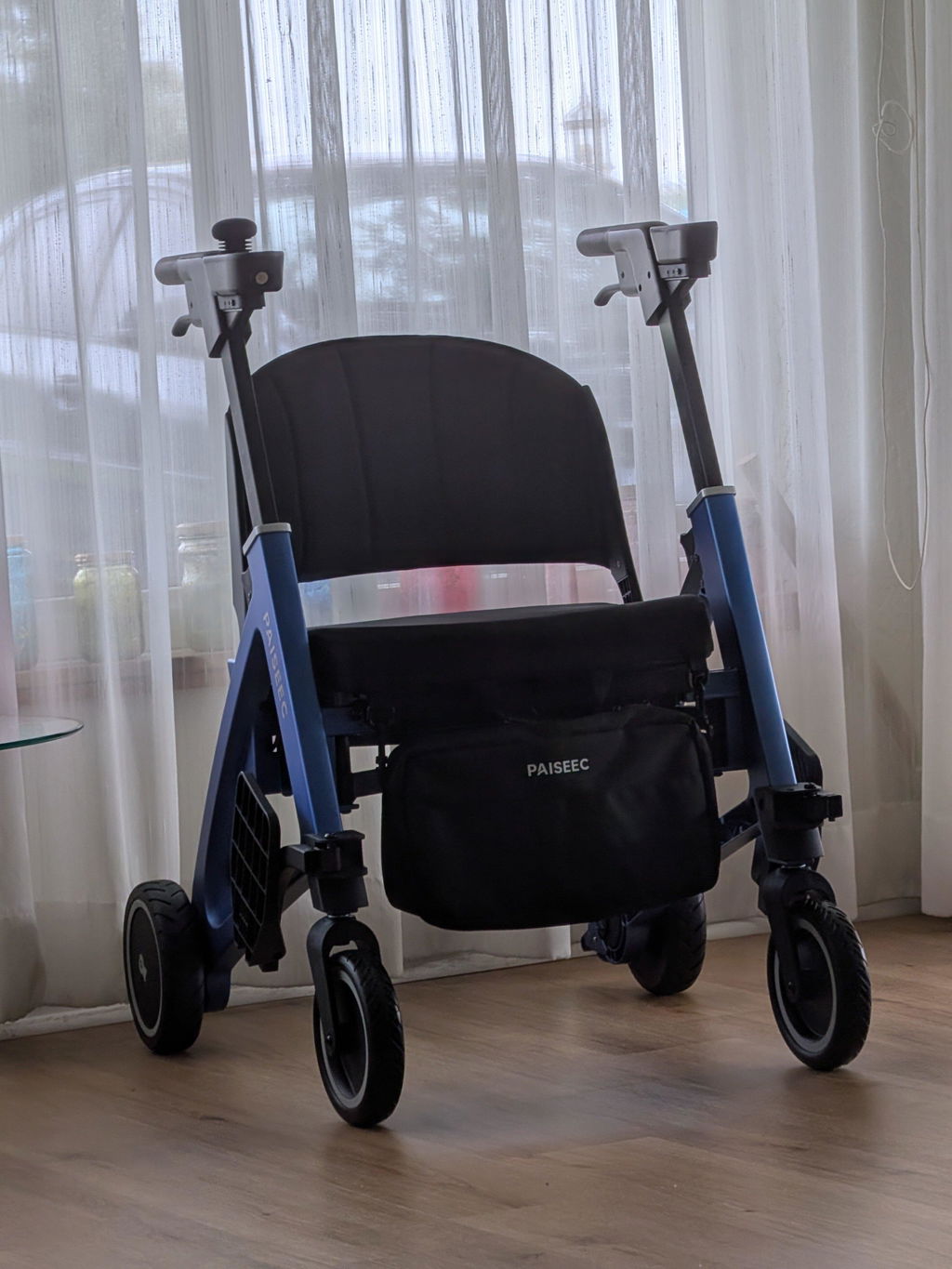
"When using it as a rollator, the chair is very quiet and pushes with ease. The backrest doesn't shake in walking mode—it's very sturdy!"
Cross-sell: Paiseec mobility lineup that fits your lifestyle
If you're exploring an electric wheelchair, Paiseec's broader lineup offers options tailored to different priorities:
-
Paiseec 2-in-1 Electric Wheelchair W1: At 42 lbs, it's ultra-light for solo gate-checking and delivers 18 miles/charge—ideal for travel and daily errands.
-
Paiseec Lightweight Electric Wheelchair Q3: A best-value, foldable 32 lbs power chair with 11 miles/charge, suited for budget-conscious users seeking portability.
-
Paiseec Carbon Fiber Electric Wheelchair Q5: Aerospace-grade carbon fiber at 22 lbs, with optional caregiver control—perfect for maximum portability and premium materials.
-
Mobility Scooters & Rollator Walkers: For users who need mixed support (scooter + walker), Paiseec's multi-function devices adapt across scenarios.
Explore the full Electric Wheelchairs collection to compare W3, W1, Q3, and Q5 side by side https://www.paiseec.com/collections/wheelchair.
How to set up and use your Paiseec W3 (6 steps)
-
Unbox and unfold: Open the frame in one step—no tools required. The W3 arrives ready to use after unfolding.
-
Install the battery: Slide the removable 24V 12Ah battery into the compartment. Ensure terminals are protected and the battery is seated firmly.
-
Power on and test joystick: Turn on the chair, then gently push the joystick forward/backward/left/right to confirm smooth motion. Operation is quiet (~60 dB).
-
Choose your mode:
-
Fold for transport: When done, fold in 3 seconds. The compact folded size (39.17" × 24.40" × 17.70") fits many car trunks.
-
Charge safely: Charge directly in the chair or remove the battery and charge via its independent port. Full charge takes ~6–7 hours.
Where the W3 shines: 3 scenarios
Scenario 1: Airport travel
-
Traditional: You gate-check a bulky chair; battery questions cause delays; spares may be rejected.
-
With W3: The 288Wh battery is airline-approved (UN38.3, IATA/FAA), with protected terminals. You declare it 48 hours ahead, carry it to the cabin if required, and resume mobility post-flight.
Scenario 2: Park trail or nature center
-
Traditional: Gravel and grass stop you; you skip the trail.
-
With W3: Rugged wheels and multi-terrain design handle gravel, grass, and dirt—letting you enjoy trails and outdoor events safely.
Scenario 3: Daily errands + walking support
-
Traditional: You switch between a power chair and a walker; carrying both is impractical.
-
With W3: One device covers self-propel, walking support (rollator), and caregiver transport—saving money and space while increasing flexibility.
FAQ: electric wheelchair questions answered
What is the maximum speed and weight capacity of the W3?
The W3 reaches a standard top speed of 3.7 mph even with a 300 lbs load, using high-performance brushless motors.
How far does the W3 go on one charge?
It delivers about 15.6 miles per charge under typical conditions.
Is the W3's battery removable and airline-approved?
Yes. The battery is removable and UN38.3 certified, meeting IATA/FAA compliance for air travel with clear labeling and protected terminals.
How long does it take to charge the battery?
Full charge takes approximately 6–7 hours.
What is the W3's frame material and weight?
The frame is aircraft aluminum alloy, and the chair weighs 49.6 lbs (battery not included); the battery weighs 8.1 lbs.
Can the W3 go up hills or ramps?
Yes. It handles up to an 8-degree slope, suitable for standard ramps and mild inclines.
Is the W3 FDA certified?
Models like the W3 carry FDA Class II Medical Device certification.
What warranty does the W3 include?
The W3 includes a 5-year limited frame warranty, 1-year limited battery warranty, and 3-month warranty on plastic components.
Can I pull the W3 when it's folded?
Yes. It can be easily pulled when folded.
Is the W3 loud in operation?
No. Brushless motors run at about 60 decibels, similar to a soft voice.
Does Paiseec sell the W3 battery separately?
Yes. The Electric Wheelchair W3 Battery is available separately for ~$300.
Where is the W3 available for purchase?
Currently sold in the United States (except Alaska and Hawaii), with plans to expand globally.
Conclusion
An electric wheelchair should deliver range, terrain capability, and flexible modes for real life. The Paiseec W3's 3-in-1 design, airline-approved battery, and multi-terrain build make it a practical, forward-ready choice for July 2026.
CTA + Brand intro
Ready to regain independence? Explore the Paiseec W3 and compare W1, Q3, and Q5 today.
Paiseec engineers lightweight, multi-functional mobility devices with advanced PAI safety—designed for everyday freedom.
Sources
-
TechNavio — Global Electric Wheelchairs Growth Analysis (2024)
-
Grand View Research — Electric Wheelchair Market Size & Forecast to 2030
-
GMI Insights — Electric Wheelchair Market Size & Forecasts Report (2024–2032)
-
Custom Market Insights — Global Electric Wheelchair Market Size 2025–2034
-
FAA/IATA — Airline Approved Electric Wheelchair 2026 Rules (Paiseec)
-
Heins Med — FAA Requirements for Flying with a Portable Travel Power Wheelchair (2025)
-
Pew/Research on Disability — Annual Disability Statistics Collection (2025)
-
PM&R KnowledgeNow — Wheelchair and Power Mobility for Adults
-
Aurora Gov — All-terrain Wheelchairs for Trail Access (2024)


Leave a comment
This site is protected by hCaptcha and the hCaptcha Privacy Policy and Terms of Service apply.