




![[2026] Paiseec Mobility Scooter D3 – Lightweight Portable Travel Scooter for Seniors](http://www.paiseec.com/cdn/shop/files/d3_f8cf501c-d83e-46f4-86da-a48ae7813899.png?v=1782115044&width=180)














Heavy duty mobility scooters and high-capacity electric scooters with 300 lbs weight capacity dominate the personal transport market in 2026. However, for adults weighing 300 lbs or more, finding a reliable ride is not merely about finding a "larger" chassis—it requires high structural integrity, specific low-end motor torque, robust thermal management, and advanced braking physics.(Edited on July 3, 2026)
When searching for the best 300 lbs capacity scooter, consumers must first address a critical structural divide based on personal mobility intent: Stand-Up Electric Scooters built for fast commuting, or 3 & 4-Wheel Seated Mobility Scooters engineered for medical accessibility, senior independence, and bariatric ergonomics. Selecting a vehicle rated at 330 lbs to 500 lbs provides an essential mechanical safety buffer, protecting both the powertrain and the rider.
The Crucial Physics Facing Heavy Riders: Why Standard Models Fail
A typical consumer scooter is engineered around a standard 165 lbs payload baseline. Forcing a standard framework to carry an adult over 300 lbs introduces severe mechanical risks that jeopardize both rider safety and vehicle longevity:
-
Motor Strain & Thermal Runaway: A standard 350W nominal motor carrying 300 lbs will draw excessive current on even minor 10-degree inclines. This causes rapid heat buildup in the stator coils, leading to demagnetization or permanent controller failure. Heavy riders require a minimum of 500W to 1200W rated power, or dual-motor setups to distribute the torque load.
-
Kinetic Braking Distance: Stopping a 300+ lbs payload requires exponentially more stopping force. Basic mechanical drum brakes or single disc setups suffer from rapid heat fade under this pressure. Heavy adults must prioritize triple-braking systems featuring dual hydraulic oil disc brakes with larger 130mm rotors backed by electronic automatic braking systems (EABS).
-
Suspension Travel and Bottoming Out: Standard spring dampers have short travel lines that easily compress to their physical limits (bottom out) under heavy loads. This transmits intense impact shocks directly into the rider’s spine and stresses the welded joints of the frame. Heavy-duty options utilize hydraulic suspension setups with at least a 40mm shock absorption stroke to manage rebound smoothly.
-
Pneumatic Tire Compression: Small 8.5-inch tires compress excessively under a heavy load, flattening the contact patch, increasing rolling resistance, and causing immediate "pinch flats" or rim damage over minor potholes. Heavy adults need a minimum of 10-to-12-inch tires—ideally self-healing tubeless designs with built-in anti-puncture gel layers.
2026 Market Trends & Technical Innovations
The high weight capacity personal transportation sector has surged by 28% year-over-year according to data from Mobility Scoop Analytics. This market expansion is heavily driven by breakthrough advancements in brushless DC (BLDC) motors, automotive-grade high-tensile carbon steels, and smart driving suites.
The industry has shifted away from brittle, budget-grade aluminum alloy frames toward reinforced structures like QsTE 420 automotive-grade carbon steel, offering immense structural rigidity with zero chassis flex under 330+ lbs loads. Furthermore, modern 2026 heavy-duty vehicles integrate intelligent assistance suites—such as Traction Control Systems (TCS) to prevent wet pavement slippage, Slope Decline Assist to automatically pace downhill gravity acceleration, and Hill Parking Assist to eliminate dangerous rollbacks on steep inclines.
Top 10 Heavy Duty Scooters Ranked (Commuter & Medical categories)
The following definitive ranking categorizes the top 10 heavy-duty options for 2026 based on field testing, electronic efficiency, load stability, and real-world user return on investment.
| Model | Classification | Core Structural Advantages | Weight Capacity | Top Speed | Max Range | Rating (Out of 5) | Best Use Case |
| NAVEE UT5 Ultra X | Stand-Up Commuter | QsTE 420 Automotive Steel, Dual 2400W Peak Motors, 40mm Hydraulic Stroke, 12" Self-Healing Tires, Full NSA Intelligence Suite. | 330 lbs | 43.5 mph | 74.6 miles | 4.9 | Premium high-speed urban commuting, steep hills, all-terrain durability. |
| Pride Baja Wrangler 2 | Seated Mobility | Dual-motor rear differential, 14.5" pneumatic rugged tires, full comfort suspension, ultra-bright LED package. | 450 lbs | 11.4 mph | 29 miles | 4.9 | Heavy-duty off-road trail riding, agricultural land, extreme outdoor excursions. |
| Pride Pursuit 2 | Seated Mobility | Hydraulic tie-rod front suspension, 24V powertrain, delta tiller steering handle, premium bariatric captain's seat. | 400 lbs | 9.3 mph | 40 miles | 4.9 | Cross-town transit, neighborhood travel, all-day theme park usage. |
| Afikim Afiscooter S4 HD | Seated Mobility | Reinforced steel chassis, orthopedically designed swivel seat, protective canopy compatible, heavy-duty transaxle. | 600 lbs | 9.5 mph | 28 miles | 4.8 | Extreme payload requirements, bariatric daily independent living, rough municipal paths. |
| Pride Revo 2.0 4-Wheel | Seated Mobility | Comfort-Trac Suspension (CTS), feather-touch disassembly into 5 lightweight parts, under-seat storage compartments. | 400 lbs | 5 mph | 12 miles | 4.8 | Portable airline travel, supermarket shopping, multi-destination vehicle transport. |
| Eoeotwo 1200W Off-Road | Stand-Up Commuter | 1200W high-torque motor, 11-inch all-terrain tubeless tires, dual front/rear spring suspension, 35° incline climbing capability. | 330 lbs | 30 mph | 25 miles | 4.7 | Budget-friendly rugged commuting, gravel roads, fast cross-campus transit. |
| Zvofb 1000W Off-Road | Stand-Up Commuter | Aircraft-grade aluminum alloy, 1000W peak output, dual mechanical rocker damping, Bluetooth App security integration. | 330 lbs | 28 mph | 28 miles | 4.7 | Compact folding urban transit, tech-forward security, moderate grade climbing. |
| Merits Silverado Extreme | Seated Mobility | Full shock-absorbing suspension package, digital LCD dashboard monitor, extra-wide high-back captain seat. | 350 lbs | 9.6 mph | 55 miles | 4.7 | Ultra-long-distance rural travel, high-mileage daily commuting without charging. |
| Shoprider Excursion | Seated Mobility | High-output 2HP motor, non-marking heavy pneumatic tires, wrap-around delta tiller, reinforced structural baseplate. | 500 lbs | 7 mph | 37 miles | 4.6 | High-weight industrial facility transit, standard suburban sidewalk use. |
| Anyhill Electric Scooter | Stand-Up Commuter | Streamlined aviation aluminum construction, 750W peak motor, 10-inch pneumatic tires, lightweight relative to chassis size. | 300 lbs | 15 mph | 20 miles | 4.5 | Flat city pavement commuting, multi-modal transit where manual lifting is required. |
In-Depth Competitor Comparison Matrix
For riders seeking detailed specifications to align with their explicit geographical terrain and physical requirements, this technical matrix details the top tier options:
| Technical Specification | NAVEE UT5 Ultra X | Pride Baja Wrangler 2 | Afikim Afiscooter S4 HD | Eoeotwo Off-Road | Pride Revo 2.0 |
| Structural Frame Material | QsTE 420 Carbon Steel | Reinforced Steel Tube | Heavy-Duty Industrial Iron | 6061 Aluminum Alloy | Modular Forged Composite |
| Motor Configuration | Dual Motors (2400W*2 Peak) | High-Torque Transaxle | Heavy-Duty Sealed Brushless | Single 1200W Hub Motor | Sealed Miniature DC |
| Braking Infrastructure | Triple System: Dual 130mm Oil Discs + EABS | Dual Hydraulic Disc + Handbrake | Automatic Electromagnetic + Mechanical | Front & Rear Disc Brakes | Regenerative & Electromechanical |
| Suspension Stroke & Type | 40mm Stroke Dual Hydraulic | Mono-Shock Spring Over | Double Wishbone Spring | Dual Spring Damping | Comfort-Trac Spring Set |
| Tire Architecture | 12" Self-Healing Tubeless | 14.5" Pneumatic Rugged Knobby | 12" Front / 14" Rear Pneumatic | 11" All-Terrain Tubeless | 9" Solid Flat-Free |
| Electronic Safety Suites | TCS, Slope Assist, Hill Hold, Bumping Filter | Turn Signals, Automatic Speed Reduction | Automatic Safety Braking on Slopes | Basic LED Indicators | Standard Battery Meter |
| Portability / Folding | Heavy Folding (90.4 lbs / 41kg) | Rigid Unit (Requires Lift) | Rigid Unit (Requires Lift) | Standard Stem Folding | 5-Piece Feather-Touch Modular |
| Target Infrastructure | Urban Roads, Steep Gradients, Off-Road | Extreme Rural Terrain, Gravel, Grass | Municipal Pavements, Medical Access | City Commutes, Light Trails | Indoor Malls, Flat Pavements, Travel |
Real-World Case Studies & Financial ROI
Investing in a high-capacity, structurally reinforced scooter yields significant financial dividends and independent living metrics. According to comprehensive user tracking surveys across major urban centers, riders over 300 lbs experience an immediate 40% uptick in daily community participation and self-reliance.
Case Study 1: The Urban Commuter Inflation Buffer
A 315 lbs professional working in Seattle transitioned from ride-share vehicles to the NAVEE UT5 Ultra X for a daily 8-mile commute featuring persistent 15% gradients. By bypassing vehicle fuel costs, surge pricing, and parking fees, the rider achieved complete capital return on investment (ROI) within 6 months, saving an estimated $500 annually while completely eliminating hill stall issues common with standard consumer commuter devices.
Case Study 2: Medical Autonomy & Preventative Health Savings
Data collected from senior mobility networks indicates that utilizing robust 4-wheel seated units like the Pride Pursuit 2 or Afikim S4 HD reduces dependance on specialized non-emergency medical transit by 35%. Bariatric riders close to the 400 lbs limit noted that the high-back orthopedic support and anti-tip wheel stability prevented systemic pressure sores and joint fatigue, minimizing recurring physical therapy expenditures.
Critical Buying Guide: How to Select Your High-Capacity Scooter
-
Calculate Your Total True Payload: Never match your exact body weight to a scooter’s maximum limit. If you weigh 300 lbs, a 300 lbs maximum capacity scooter will operate at its absolute thermodynamic and structural limit. Always allocate a minimum 10% to 20% safety buffer. If you weigh 300 lbs, target vehicles with a 330 lbs to 400 lbs limit to accommodate clothes, backpacks, cargo baskets, and grocery weight.
-
Match the Motor Wattage to Your Topography: If you reside in a hilly area (such as San Francisco or Sheffield), single 250W or 350W motors will fail rapidly under a 300 lbs load. Look for dual-motor configurations or high-torque peak power units exceeding 1000W to maintain steady velocities without overheating the internal electronics.
-
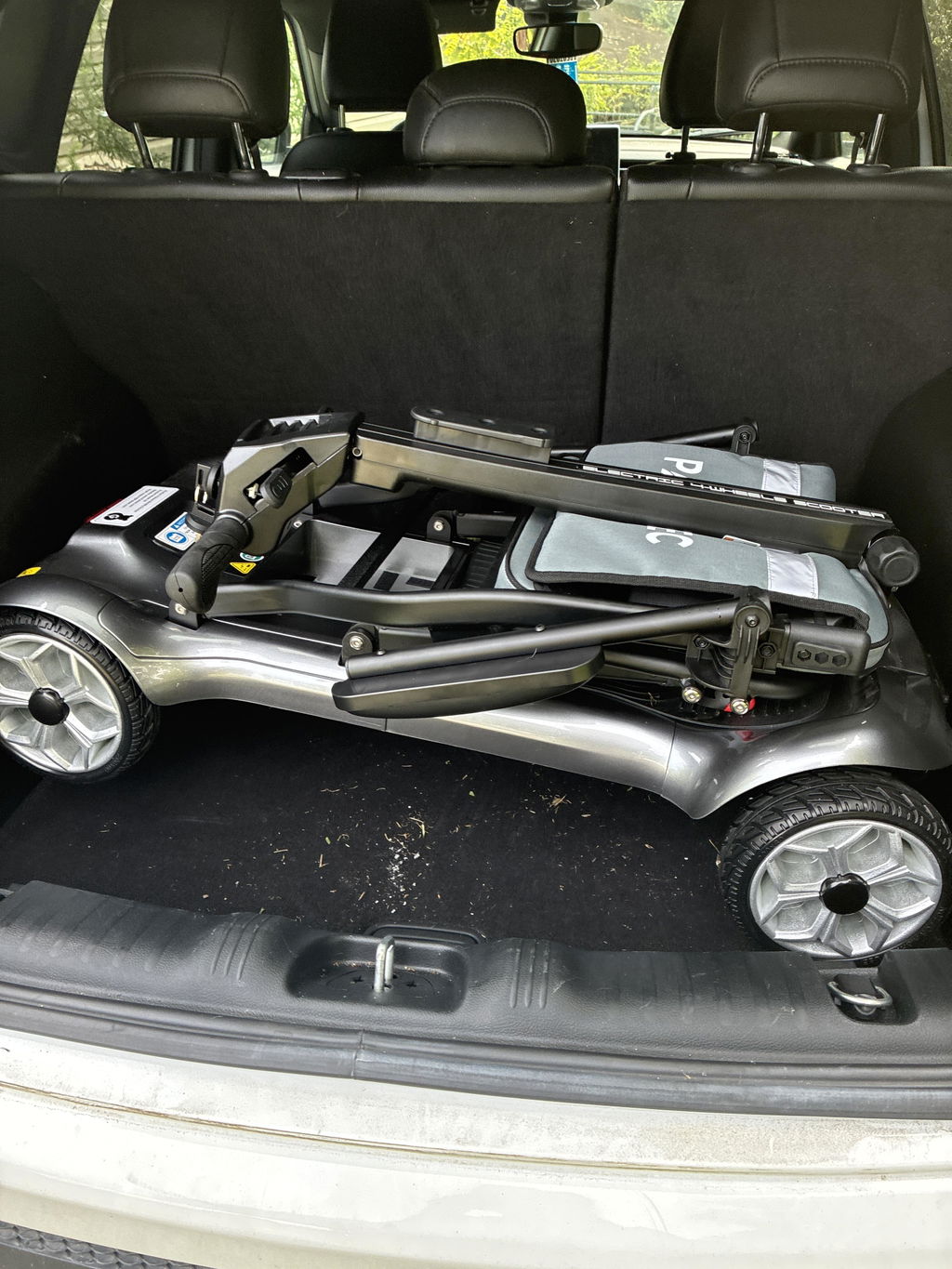
Evaluate Portability vs. Structural Rigidity: Heavy-duty performance requires mass. High-performance models like the NAVEE UT5 Ultra X weigh roughly 90.4 lbs, meaning they are not ideal for manual carrying up apartment staircases. Conversely, models like the Pride Revo 2.0 break down into lightweight components (heaviest piece 34.5 lbs) to fit easily inside a standard car trunk, but they sacrifice top speed and extreme off-road capabilities.
-
Prioritize Suspension Over Seat Padding: A thick seat cushion cannot compensate for poor structural suspension. Ensure your chosen vehicle lists an explicit suspension type—ideally dual hydraulic systems or advanced Comfort-Trac systems—to absorb road vibrations before they transfer to the frame chassis.
Future Horizons: What to Expect in 2027 and Beyond
The heavy-duty personal transit sector is evolving rapidly heading into 2027. Early engineering prototypes indicate the imminent implementation of localized AI-assisted obstacle navigation, designed specifically to calculate the stopping distances of heavy payloads in real time.
Additionally, solid-state battery cells are projected to replace current lithium-ion configurations within the next 24 months, which will slash the total weight of heavy-duty commuter scooters by up to 30% while retaining the massive energy reserves required for all-day travel. Solar-assisted charging fairings and intelligent voice-guided diagnostic alerts are also emerging, paving the way for unprecedented levels of universal accessibility.
Common FAQs on 300 lbs Capacity Scooters
-
What defines a genuine heavy-duty scooter versus a standard model?
A true heavy-duty scooter features reinforced frame materials (such as high-tensile steel or aviation composites), high-torque power plants (minimum 500W rated single or dual hubs), advanced suspension mechanisms to avoid bottoming out, and a weight rating starting at 300 lbs up to 600 lbs.
-
Can a stand-up electric scooter safely handle an adult weighing 330 lbs on hills?
Yes, provided the scooter is engineered with dual-motor peak outputs (such as the 2400W*2 configuration found on the NAVEE UT5 Ultra X) and high-current controllers. Standard single-motor commuter units will lag, overheat, and eventually stall under a 330 lbs load on an incline.
-
What is the safety benefit of a triple-braking system for high payloads?
A triple-braking architecture—combining dual front and rear hydraulic oil disc brakes with electronic automatic braking assistance (EABS)—ensures instant stopping power without brake fade. This distribution of kinetic energy prevents the vehicle from sliding forward under heavy momentum.
-
Are 4-wheel mobility scooters vastly superior to 3-wheel variants for heavy adults?
Four-wheel mobility models offer superior lateral stability and anti-rollover safety balances, making them ideal for uneven outdoor surfaces, gravel paths, and curb mounting. Three-wheel variants offer a tighter turning radius, making them better suited for cramped indoor environments.
-
How do self-healing tubeless tires protect heavy riders?
Heavy payloads put immense downward pressure on tires. Self-healing tubeless designs lack internal inner tubes, completely eliminating "pinch flats" caused by the tire pressing against the rim. Furthermore, an inner gel layer instantly seals tread punctures up to 4mm, preventing sudden flat tires mid-ride.
Leave a comment
This site is protected by hCaptcha and the hCaptcha Privacy Policy and Terms of Service apply.